

FLASHBOND™ UV/LED-Cured Epoxy Adhesives

UV Cure Epoxies

FLASHBOND™ is Epoxyset’s line of cationic UV/LED-curable epoxy adhesives, formulated to combine the rapid curing advantages of light-activated systems with the strength and high glass transition temperatures typically associated with conventional epoxy chemistries. Unlike some light-curable materials, these adhesives are not affected by oxygen inhibition resulting in tack free surface. As single-component systems, FLASHBOND™ adhesives require no mixing, offer unlimited pot life prior to activation, and cure quickly when exposed to UV or LED light.

UV + Thermal Hybrid Options

Hybrid formulations offer UV tacking for rapid initial alignment, followed by a secondary thermal cure for final bond development. This approach allows components to be positioned and secured within seconds under UV exposure, then batch-processed through heat curing for completion. The result is a streamlined assembly process that supports precise placement while delivering reliable bond performance comparable to conventional thermally cured epoxies.
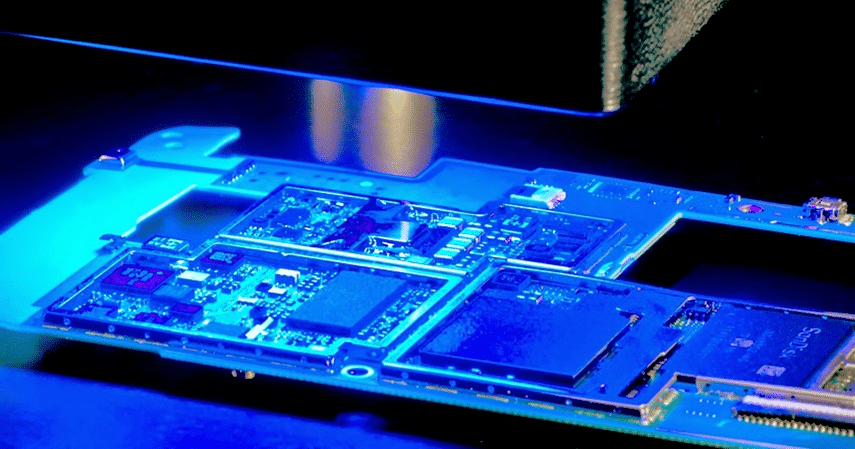
Uv flood over pcb
Product Chemistry Viscosity (cps) Service Temperature Wavelength Datasheet
UV-2910DC Epoxy 2800 -55°C-150°C 365, 405 Download
UV-5608DC Epoxy 5500 -55°C-175°C 365, 405 Download
UV-8701E Epoxy 5800 -55°C-200°C 365, 405 Download
UV-8300LV Epoxy 2500 -55°C-200°C 365, 405 Download
UV-6502CL Epoxy 300 -55°C-200°C 310, 365 Download
UV-3700F Epoxy 100,000 -55°C-200°C 365, 405 Download
UV-5403S Epoxy 8000 -55°C-150°C 325, 365 Download
UV-8403 Epoxy 500 -55°C-200°C 310, 365 Download
UV-3607HT Epoxy 4000 -55°C-150°C 310, 365 Download
UV-3720 Epoxy 70,000 -55°C-175°C 365, 405 Download

Frequently Asked Questions


1. What is a UV cure adhesive?
A UV cure adhesive is a material that hardens when exposed to light at the wavelengths specified for its formulation. It allows manufacturers to control when curing begins and can support fast assembly. Typical types are acrylated urethanes and epoxies.

2. How long does a UV adhesive take to cure?
Cure time depends on the adhesive, light wavelength and intensity, exposure time, bond thickness, and the amount of light that reaches the bond. Use the product’s recommended cure schedule and verify the bond under actual production conditions. In general, however it can be as quick as seconds (or <1 sec) up to minutes.

3. What should I consider when choosing a UV cure adhesive?
Start with the materials being bonded, required bond strength and flexibility, bond-line thickness, operating conditions, and whether light can reach the entire adhesive area. Then match the adhesive’s cure wavelength to the curing equipment and test the finished assembly under its intended conditions.

4. What are the advantages and disadvantages of UV cure adhesives?
Advantages of UV cure adhesives rely mostly on speed of cure which allows for higher throughput for manufacturing. Traditional adhesives can take hours or days to fully cure while most UV cure systems can cure in seconds. Most UV cure adhesives are one-component material which means no weighing or mixing required. Disadvantages include lack of variety when compared to traditional materials, inability to cure fully if adhesive cannot be exposed to light (i.e through opaque substrates), limitations in cure depth, and sometimes larger capital expense for UV lamps and curing systems.