

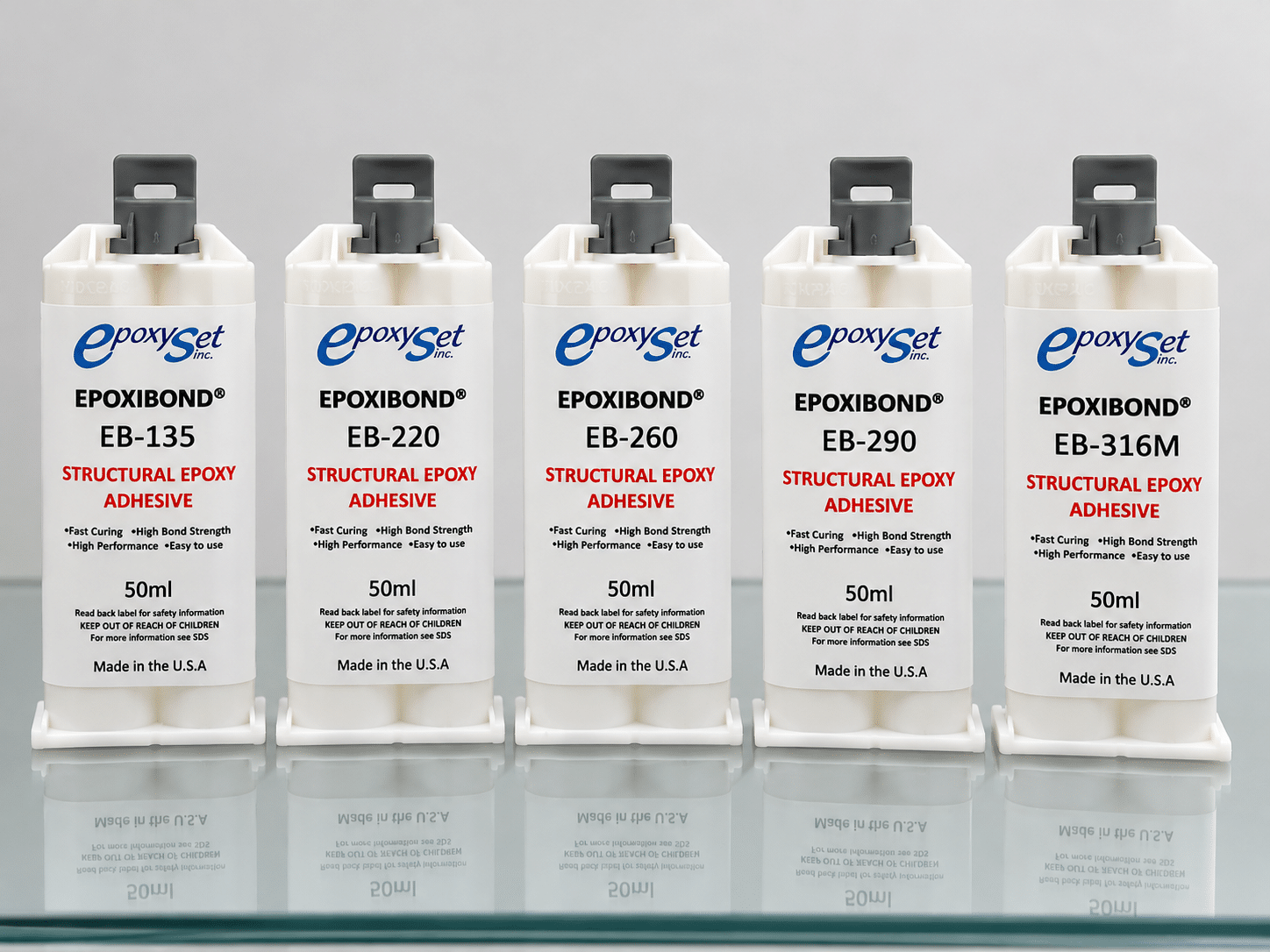
Structural epoxies are adhesives designed to transfer mechanical loads between bonded parts. They are used when a joint must withstand forces such as pulling, sliding, vibration, impact, or repeated loading throughout its service life.
They can replace or supplement screws, rivets, and welds, particularly when joining different materials or when drilling holes would weaken the assembly.
How structural epoxies work
An epoxy resin reacts with a hardener to form a crosslinked thermoset polymer. The cured material adheres to the surfaces and transfers forces across the joint.
Common formats include:
- Two-component systems: Resin and hardener are mixed before application. Many cure at room temperature; heat can accelerate curing.
- One-component systems: Premixed formulations typically activated by heat.
- Film adhesives: Controlled-thickness materials commonly used in composite and aerospace manufacturing.
Many demanding applications use toughened epoxies. These incorporate modifiers that help absorb energy and resist crack growth. A toughened adhesive can perform better under impact, peel, and fatigue than a harder, more brittle epoxy—even if their published shear strengths are similar.
Where they are used
| Application | What the epoxy does | Important properties |
| Metal assembly | Bonds brackets, panels, housings, and reinforcements | Shear strength, surface adhesion, corrosion durability |
| Composite assembly | Joins carbon fiber or fiberglass parts to each other or metal | Toughness, fatigue resistance, controlled bond thickness |
| Motors and industrial equipment | Secures magnets, components, and mechanical assemblies | Temperature resistance, vibration durability, chemical resistance |
| Aerospace and transportation | Bonds panels, inserts, stiffeners, and mixed materials | Strength relative to weight, environmental durability, qualification |
| Electronics and instrumentation | Secures connectors, sensors, and supporting components | Low stress, dimensional stability, electrical insulation |
| Medical devices | Bonds instrument components, handles, housings, and sensor assemblies | Mechanical reliability, sterilization compatibility, appropriate biological evaluation |
Why manufacturers choose them
The main advantages are:
- Distributed loading: Force transfers over the bonded area, reducing concentrated loads around individual fasteners.
- Joining different materials: Useful for combinations such as aluminum and fiberglass.
- Fewer holes and visible fasteners: Can simplify fabrication and improve appearance.
- Bonding and sealing together: A continuous joint can also help exclude fluids.
- Adjustable manufacturing behavior: Products offer different working times, flow characteristics, and cure schedules.
These benefits depend on the joint design and manufacturing process. An adhesive’s strength alone does not determine the finished assembly’s strength.
Popular Epoxyset’s Products
The following are well-known commercial examples, not a sales ranking. The listed strengths are distinguishing features, not claims that the products are interchangeable.
| Product | Main characteristics | Typical reason to consider it |
| EPOXIBOND
EB-220 |
Toughened two-component epoxy; approximately 20-minute working time; strong impact resistance | General metal and composite assemblies requiring durable structural bonds |
| EPOXIBOND EB-260 | Two-component epoxy with high shear and peel adhesion; approximately 60-minute working time | Larger or complicated assemblies that need more positioning time |
| EPOXIBOND EB-290 | Toughened, room temperature curing epoxy with extended working life and high peel and shear strength | General industrial bonding where parts require adjustment during assembly |
| EPOXIBOND EB-316M | Multipurpose two-component epoxy; room-temperature cure; high strength and toughness | General assembly involving a variety of materials |
Epoxyset Structural Epoxy Adhesives | EpoxySet, Inc.
Structural epoxies for medical devices
For the medical device applications we discussed, two commercial examples are particularly relevant:
| Product | Manufacturer-described features | Potential application fit |
| EPOXIBOND EB-135 | Clear, two-component, room temperature curing epoxy; low viscosity; impact resistance; approximately 30-minute working life | Small bonded assemblies requiring clarity, component staking, and small potting applications |
A general industrial structural epoxy should not automatically be treated as a medical-grade substitute. For patient-contacting applications, the biological evaluation must address the finished device, including adhesive cure, manufacturing residues, and sterilization. The FDA evaluates finished devices rather than approving their constituent materials individually. www.fda.gov
What determines whether a structural epoxy will succeed
The most important selection factors are:
- Substrates and surface preparation. Oil, mold release, weak oxide layers, or contamination can cause failure at the surface even when the epoxy itself is strong.
- Load direction. Overlap joints generally favor shear loading. Joint edges that experience peeling or prying need particular attention.
- Bond thickness. A controlled gap usually performs more consistently than an uncontrolled thick layer or a joint squeezed nearly dry.
- Service conditions. Evaluate strength at the actual operating temperature and after moisture, chemicals, cleaning, or sterilization exposure.
- Manufacturing requirements. Working life, dispensing viscosity, fixture time, and cure temperature must fit production.
- Long-term performance. Fatigue, creep, and environmental aging can matter more than initial lap shear strength.
For an initial comparison, EB-220, EB-260, EB-290, and EB-316M cover common industrial structural bonding needs. EB-135 provides more relevant starting points for medical device assembly, subject to the actual substrates, loading, sterilization process, and patient contact requirements.