

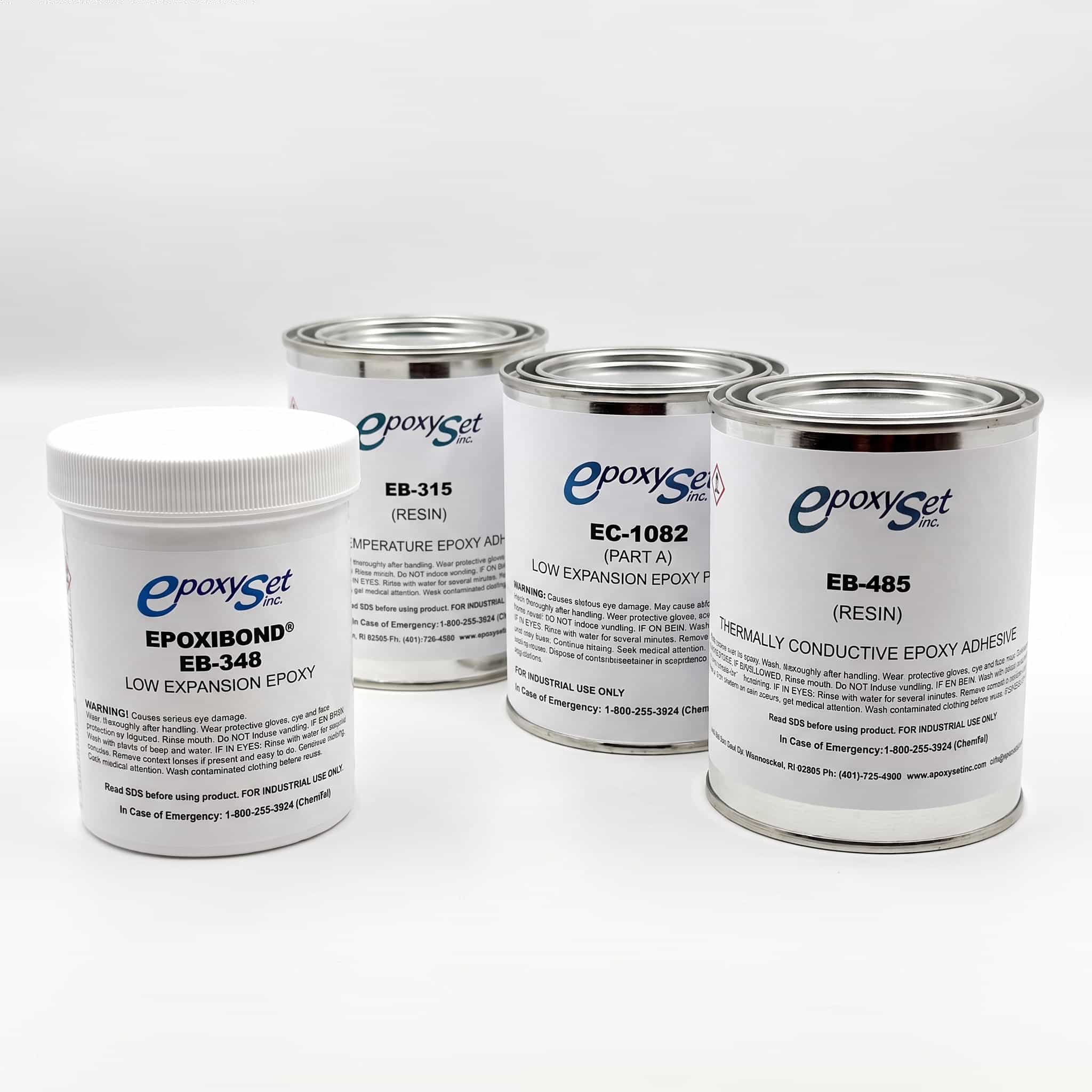
Low expansion refers to a low coefficient of thermal expansion (CTE)—the amount a cured material expands or contracts as its temperature changes. CTE is commonly reported in parts per million per degree Celsius (ppm/°C). Specialty low-expansion epoxies can have published values around 9–18 ppm/°C, depending on the formulation and measurement conditions.
Low-expansion epoxies help maintain dimensional stability in aerospace and defense assemblies exposed to temperature changes. They are particularly useful where small movements can affect optical alignment, sensor accuracy, or electronic reliability.
Manufacturers use selected fillers and resin systems to control expansion and improve dimensional stability. Fillers can also affect cure shrinkage, viscosity, thermal conductivity, and electrical properties, allowing formulations to meet multiple assembly requirements at once. These materials are available for bonding, sealing, potting, and encapsulation.
Why Low Expansion Matters
Aerospace and Defense assemblies often combine metals, ceramics, glass, semiconductor materials, and composites. When these materials expand at different rates, temperature changes can create stress at bonded interfaces. A properly selected epoxy helps manage that mismatch and maintain the assembly’s geometry. However, CTE must be considered together with adhesive stiffness, bond thickness, and substrate properties; the lowest CTE does not automatically produce the lowest joint stress.
Low thermal expansion and low cure shrinkage are separate properties. Low cure shrinkage helps preserve component position during manufacturing, while low CTE limits dimensional changes during service. Precision assemblies frequently need both
The following are representative application opportunities. Suitability depends on the specific adhesive, joint design, and qualification results.
|
Application |
Typical uses |
Value of low expansion |
|
Precision optics and imaging |
Bonding lenses, prisms, mirrors, optical mounts, and detector assemblies |
Helps preserve alignment and limit thermally induced distortion. |
|
Satellite and spacecraft instruments |
Bonding optical components, instrument supports, and selected payload assemblies |
Supports dimensional stability during thermal cycling; space applications may also require low outgassing. |
|
Fiber optic and photonic assemblies |
Securing fibers in ferrules, bonding optical packages, and fixing aligned components |
Helps maintain fiber position and optical coupling as temperature changes. |
|
Avionics and defense electronics |
Potting or encapsulating selected circuit assemblies and bonding ceramic electronic packages |
Can reduce expansion mismatch around sensitive components and interfaces. |
|
Sensors and precision instrumentation |
Bonding sensor elements, detector packages, and mechanically sensitive assemblies |
Helps limit dimensional movement that could affect calibration or repeatability. |
|
Thermal management assemblies |
Bonding electronic packages to heat spreaders or supporting selected power components |
Formulations that combine low CTE with thermal conductivity can improve heat transfer and dimensional stability. |
|
Cryogenic instrumentation
|
Bonding selected optical, electronic, and sensing components used at very low temperatures |
Appropriately qualified formulations can support stable joints through cooling and warming cycles. |
**Manufacturer literature supports the use of low-CTE epoxies in aerospace electronics, optics, semiconductor packaging, fiber optics, and cryogenic assemblies. The specific benefits in the table are engineering applications of those properties, rather than a claim that every low-expansion epoxy is qualified for each use.**
Properties to evaluate when selecting an epoxy
- CTE across the operating temperature range: Check the measurement range and values below and above the glass transition temperature (Tg). Expansion can increase substantially above Tg; one published low-CTE formulation lists 19 ppm/°C below Tg and 68 ppm/°C above it.
- Stiffness and stress accommodation: Evaluate modulus and the bonded materials together. A rigid adhesive may preserve alignment but transfer more stress into a fragile component.
- Cure shrinkage and processing: Consider cure temperature, post-cure requirements, flow, and the ability to fill the intended geometry. Thick potting sections also require attention to heat generated during curing.
- Thermal and electrical performance: Confirm whether the application needs heat conduction, electrical insulation, or electrical conductivity. These properties depend on the particular formulation.
For aerospace and defense programs, low-expansion epoxy should be selected as part of the complete assembly design. Its greatest value is in applications where temperature-driven movement must be controlled, while the final choice must also satisfy adhesion, toughness, processing, environmental, and program qualification requirements.
Epoxyset’s Low Expansion Epoxy Adhesives: